HomeVercingetorix
No. 03 · Gaul
Vercingetorix
The Arvernian noble who united Gaul against Caesar and surrendered at Alesia.
died 46 BCE
History
Vercingetorix was a noble of the Arverni, the people of the Auvergne in central Gaul. His father, Celtillus, had tried to make himself king over the tribe and had been put to death by his own countrymen for it. In 52 BCE, with Caesar's conquest of Gaul nearly complete and revolt already burning farther north, Vercingetorix argued for a wider war. An uncle drove him out of Gergovia. He raised his own band, returned, and took command of the Arverni. Neighboring peoples joined him. For one campaigning season he was the closest thing Gaul had to a single general.
He understood the army he was fighting. Roman legions were hard to beat in a set battle when they were fed and concentrated. He pressed a scorched-earth policy, emptying the stores a Roman column could live on, and he accepted a siege only where the ground helped him. At Gergovia, Caesar's assault failed, and the legions took losses they did not often take in Gaul. The coalition then gathered at Alesia, a hill town of the Mandubii. Caesar invested it with the engineering still associated with his name: an inner ring of forts to keep Vercingetorix in, and an outer ring to keep a relief army out. A very large Gallic force did arrive. In Caesar's own account the fighting on the outer line nearly broke the Romans. It did not break them. The relief army scattered. Inside the town the food was gone.
Vercingetorix surrendered. The ancient accounts, Caesar's among them, say he came out into the Roman position and gave himself up, offering his own person for his men. He was kept alive because Caesar wanted him for a triumph in Rome. That triumph was held in 46 BCE, six years after Alesia. Vercingetorix was walked in the procession and then executed. The war he had led was over, and with it the independence of the Gallic peoples who had joined him. Roman Gaul, and much later France, grew on that ground.
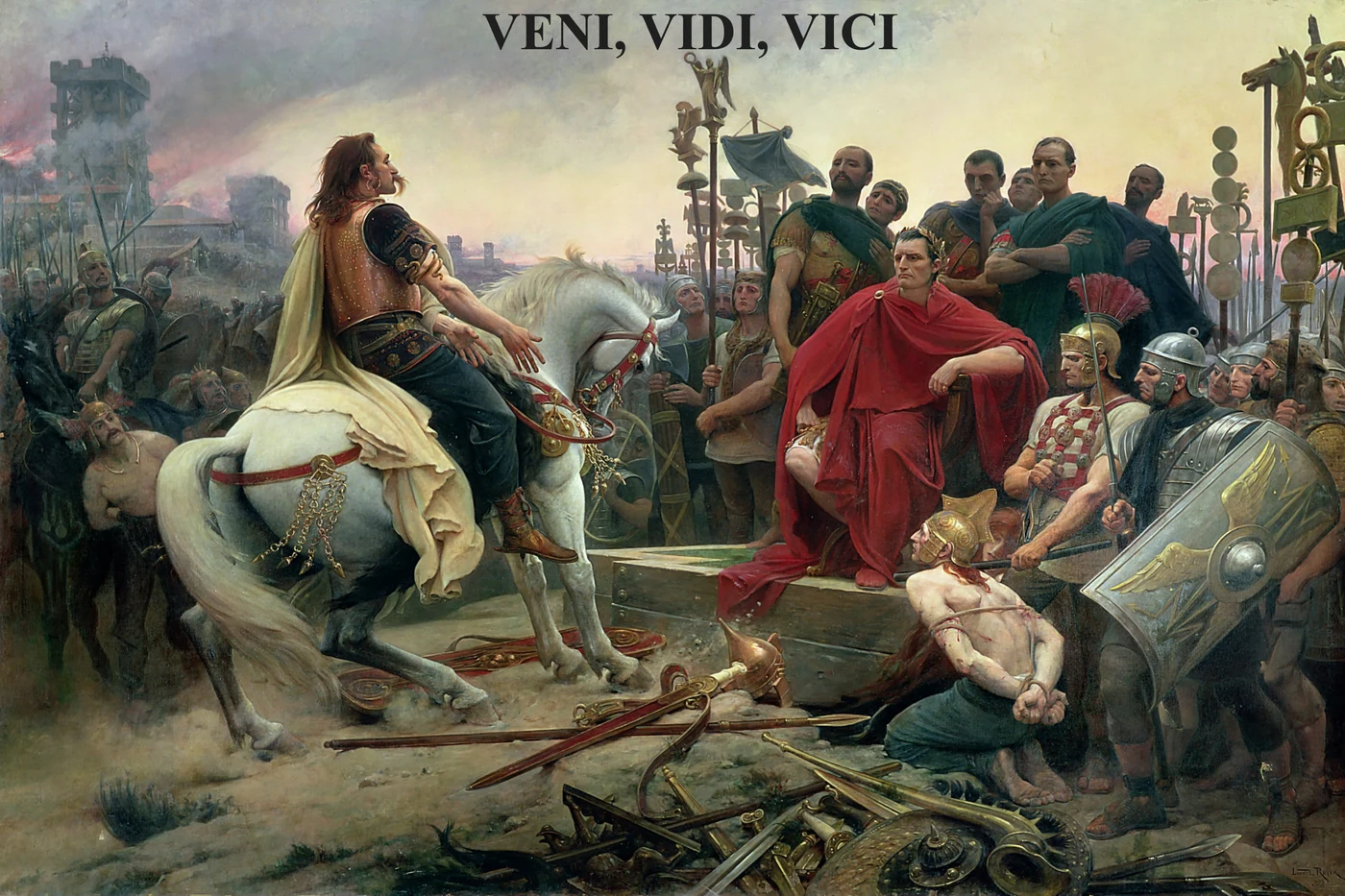
Nineteenth-century France took him back as a national ancestor. After the defeat of 1870, a story of a noble surrender had a particular use, and painters gave the defeated man the dignity the victor's commentaries had not. Lionel Royer's canvas of 1899 is the version that entered the schoolbooks: Vercingetorix on horseback, Caesar seated, the arms thrown down at the Roman's feet. The picture is a document of the Third Republic as much as of 52 BCE, which is part of why it still circulates.
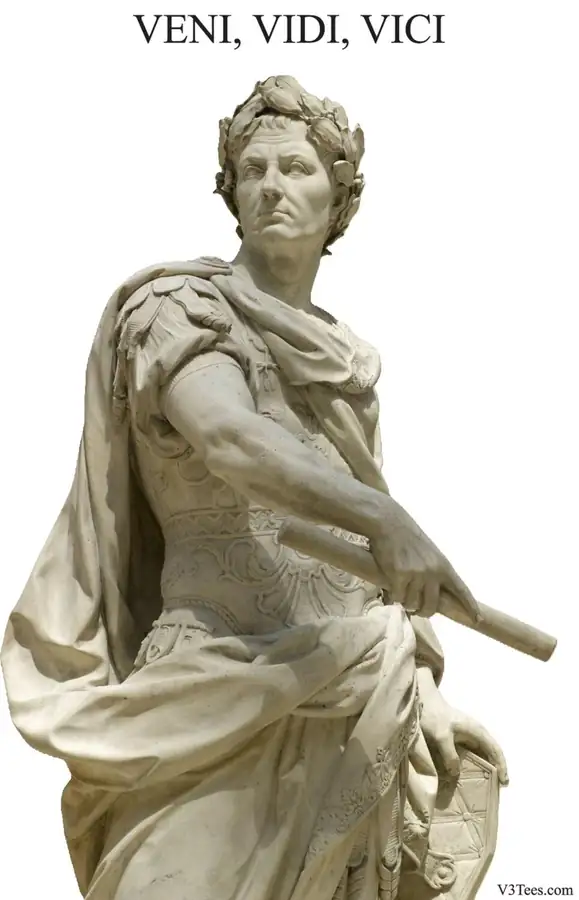
He is here beside Caesar on purpose. A catalog of conquerors that showed only the Roman side of Alesia would be missing the name the victory was won against. Vercingetorix lost. He is also the reason that year in Gaul still has two commanders in it, and the reason a Roman three-word boast has an answer on the other side of the same war.
About the art
The painting is Lionel Royer's Vercingétorix devant César, also known as Vercingétorix jette ses armes aux pieds de César. It is an oil of 1899, shown that year at the Paris Salon, and it hangs in the Musée Crozatier at Le Puy-en-Velay. Royer, who had fought in the Franco-Prussian War, composes the surrender so that the Gaul on the pale horse dominates the seated Caesar. The print on the shirt reproduces that public-domain canvas. Royer died in 1926.
Buy on Amazon
Vercingetorix is printed and sold by Amazon Merch on Demand. Choose a product and a marketplace. United States listings come first. Prices change, so they are not listed here.
Standard t-shirt
Premium t-shirt
V-neck t-shirt
Tank top
Long sleeve t-shirt
Sweatshirt
Pullover hoodie
Zip hoodie
As an Amazon product, orders, shipping and returns are handled by Amazon.