HomeJoan of Arc
No. 01 · France
Joan of Arc
A farmer's daughter who turned the Hundred Years' War in a single campaign.
c. 1412–1431
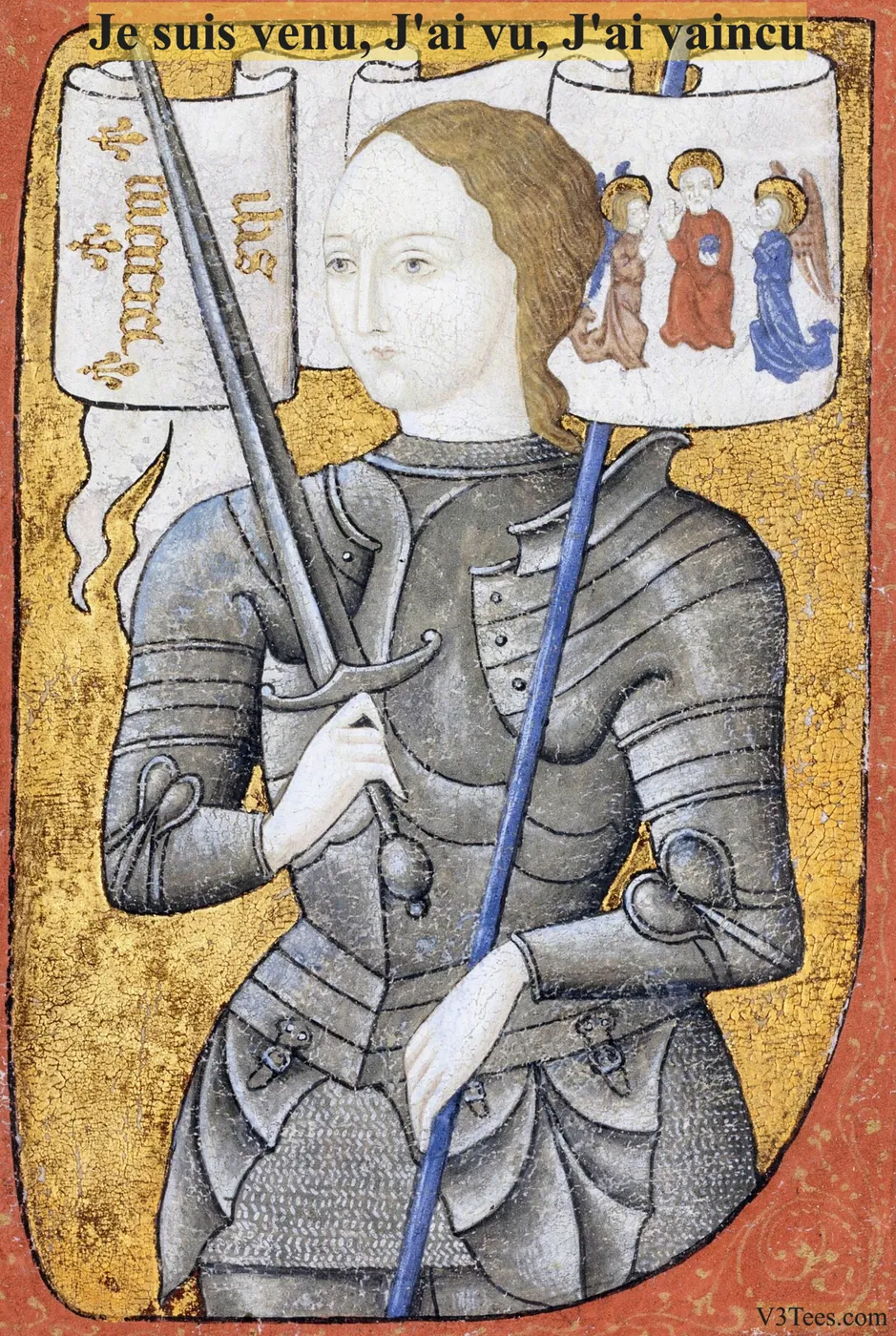
FrenchJe suis venu, j'ai vu, j'ai vaincu
History
Joan of Arc was born about 1412 in Domrémy, a village in the Meuse valley, during the Hundred Years' War. England and its Burgundian allies held Paris and much of northern France. The Treaty of Troyes in 1420 had named Henry V of England heir to the French crown, and after his death the child Henry VI was proclaimed king of France. Charles, the Dauphin, still held the Loire and the south. He had not been anointed. In France, anointing was what made a king.
Joan was the daughter of a farming family. In 1428 she told local captains that saints Catherine, Margaret, and Michael had charged her with lifting the siege of Orléans and bringing the Dauphin to his coronation at Reims. She reached Charles at Chinon in the late winter of 1429. Clerics examined her at Poitiers. A relief force then went up the Loire, and she rode with it, alongside captains who already held command. She entered Orléans on 29 April. By 8 May the English had abandoned the siege. In June the French recovered the Loire towns and, at Patay on 18 June, defeated an English army in open country. On 17 July 1429 Charles VII was crowned in Reims Cathedral, with Joan present. One campaigning season had produced the ceremony the Valois cause had gone years without.
The war did not end at Reims. An attack on Paris that September failed, and Joan was wounded. On 23 May 1430 she was captured outside Compiègne by Burgundian troops and sold to the English. At Rouen, in a city under English occupation, a church court tried her for heresy. The case turned on her claim of direct guidance from saints, and on her refusal to dress as the judges thought a woman should. She was burned in the market square on 30 May 1431. She was about nineteen. The king whose coronation she had forced did not ransom her.
In 1456 a second court nullified the conviction. The reversal also protected a king who had been crowned through the work of a woman condemned as a heretic. Her reputation grew anyway. She was beatified in 1909 and canonized in 1920, and she is a patron saint of France. The French Republic kept her as a national figure as well. Chroniclers, playwrights, and much later the strategy games that stage the siege of Orléans all return to the same few months of 1429.
She belongs in this lineup because the authority was not a title she inherited and not an army she had spent a lifetime building. She changed the direction of a dynastic war in a single season, and she was killed for the manner of it. The shirt uses a fifteenth-century miniature of her in armor and prints the three verbs in French, the language of the kingdom she fought to keep.
About the art
The figure is a fifteenth-century manuscript miniature of Joan in plate armor, sword in one hand and banner in the other, on a gold ground in the manner of late medieval French illumination. The artwork is public domain. The French line on the banner, “Je suis venu, j'ai vu, j'ai vaincu,” belongs to the V3Tees design. A painter of the 1400s would not have lettered that modern sentence. The face, the armor, and the gold field are the historical image. The three verbs are the brand.
Buy on Amazon
Joan of Arc is printed and sold by Amazon Merch on Demand. Choose a product and a marketplace. United States listings come first. Prices change, so they are not listed here.
Standard t-shirt
Premium t-shirt
As an Amazon product, orders, shipping and returns are handled by Amazon.