HomeAlexander the Great
No. 04 · Macedon
Alexander the Great
The Macedonian king who led an army from Pella to the Indus and died at thirty-two.
356–323 BCE
GreekΗΛΘΟΝ, ΕΙΔΟΝ, ΕΝΙΚΗΣΑ
EnglishI came, I saw, I conquered
History
Alexander III of Macedon was born in 356 BCE at Pella, the son of King Philip II and of Olympias. Philip had already turned Macedon from a kingdom on the northern edge of the Greek world into its dominant power. His army was built around the sarissa, the long pike, and after the battle of Chaeronea in 338 BCE he imposed a settlement on the Greek cities. Alexander grew up inside that project. Aristotle was brought north to tutor him. When Philip was assassinated in 336, Alexander took the throne at about twenty, put down the revolts that followed a royal murder, and the next year destroyed Thebes as a warning to the rest of Greece.
In 334 he crossed the Hellespont into the Persian Empire of Darius III, the campaign his father had planned and had not lived to lead. He won at the Granicus, then in 333 at Issus, where Darius was present and fled the field. The war became a pursuit of a king and a takeover of his realm. Tyre, on its island, fell in 332 after a siege of months. In Egypt Alexander was received as the ruler who had replaced Persia, and he founded Alexandria. In 331 at Gaugamela, east of the Tigris, he broke the largest army Darius assembled. Babylon and Susa opened their gates. Persepolis, a ceremonial capital of the empire, was occupied and burned. Darius was murdered in 330 by nobles of his own court, Bessus among them. Alexander hunted the claimants and kept moving, through Central Asia and on to the Indus.
At the Hydaspes in 326 he defeated the Indian king Porus. The histories say he was impressed by the way Porus had fought and restored him as a vassal ruler. It was the last of the great battles. On the Hyphasis, the river Beas, the Macedonian army refused to march farther east. Alexander turned back. The return through the Gedrosian desert cost the column heavily in men. He reached Babylon, drew plans for further wars, and in June 323 fell ill and died. He was thirty-two. Ancient writers do not agree on the illness, and rumors of poison began almost at once. He left no heir who could hold what he had conquered. His generals, later called the Diadochi, fought for decades over the pieces. The Hellenistic kingdoms that came out of those wars, in Egypt, Syria, and Macedon, carried Greek cities and Greek administration across the Near East for centuries.
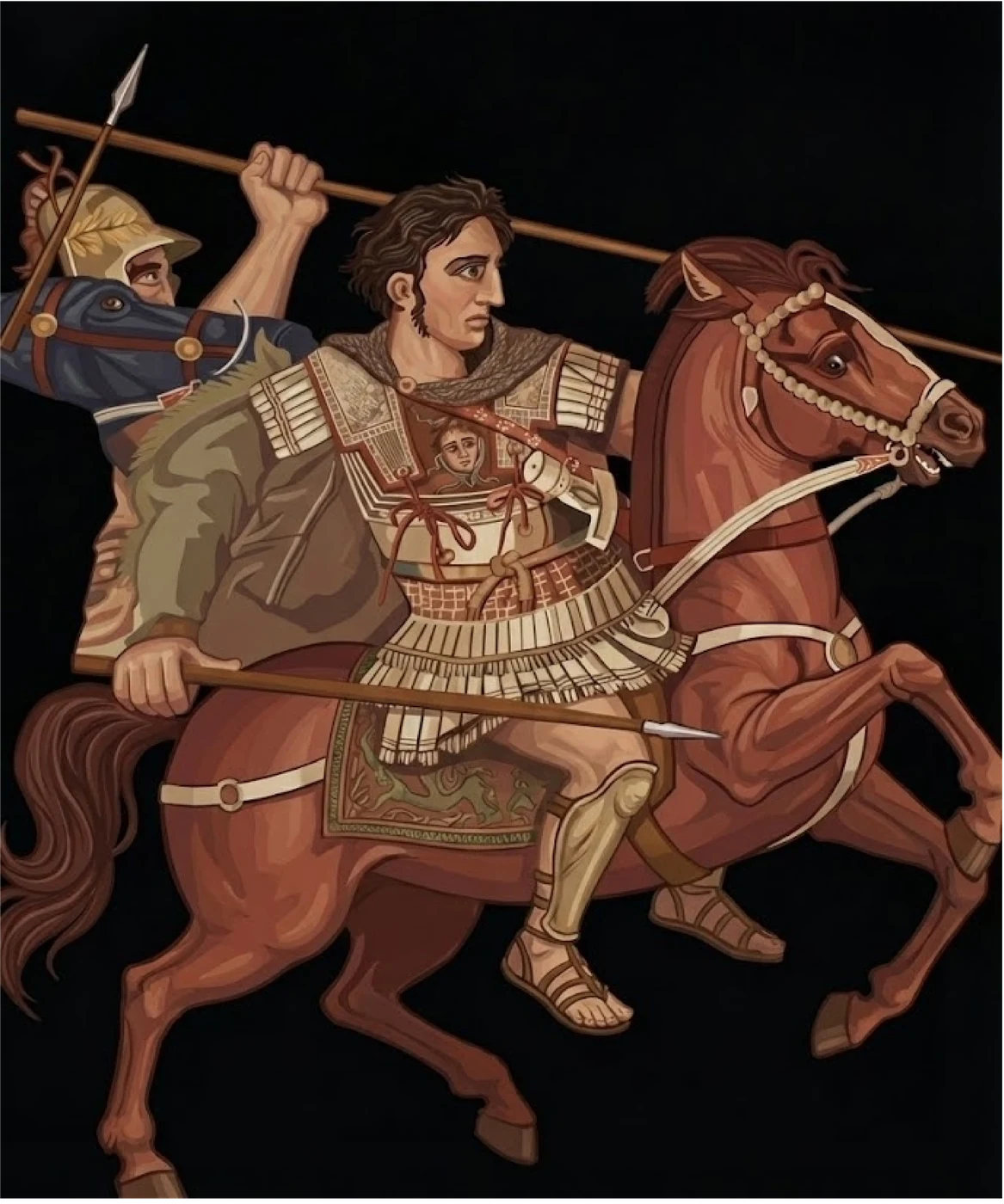
Later commanders measured themselves against him, Caesar included. The shirt reaches past the European paintings of a blond king in fancy armor and uses a picture made in the ancient world: a detail of the Alexander Mosaic, Alexander on horseback closing with Darius in his chariot. The battle depicted is generally identified as Issus. The three verbs are printed on the design in Greek and in English, over a work by people who already treated him as a legend.
About the art
The picture is a detail of the Alexander Mosaic, a Roman floor mosaic from the House of the Faun at Pompeii, now in the National Archaeological Museum of Naples. Ash from Vesuvius buried it in 79 CE. It was uncovered in 1831. Scholars usually date the mosaic to the late second or early first century BCE and read it as a copy of a Hellenistic painting of Alexander facing Darius III. The battle is generally taken to be Issus, fought in 333 BCE. The Greek and English lines of “I came, I saw, I conquered” are printed on the shirt. They are not part of the ancient mosaic. The mosaic itself is public domain.
Buy on Amazon
Alexander the Great is printed and sold by Amazon Merch on Demand. Choose a product and a marketplace. United States listings come first. Prices change, so they are not listed here.
Standard t-shirt
As an Amazon product, orders, shipping and returns are handled by Amazon.