HomeHuitzilopochtli
No. 09 · Mexica
Huitzilopochtli
The hummingbird god of the sun and of war, patron of the Mexica. A god, not a mortal commander.
Patron god
History
Huitzilopochtli is not a general and not a king. He is the patron god of the Mexica, the people better known in English as the Aztecs, and a god of the sun and of war. His name is usually translated Hummingbird of the Left, or Hummingbird on the Left. In Mexica cosmology the left side was associated with the south, so the name also carries a direction. In the stories the Mexica told about themselves, he was the deity who had led them out of a place of origin called Aztlan and had promised them a home when they saw a particular sign.
That sign, an eagle perched on a prickly pear growing from rock in the lake, is the founding image of Tenochtitlan. Mexica accounts place the founding in the early fourteenth century, traditionally 1325, on an island in Lake Texcoco. The city that rose there became the center of a tribute empire across central Mexico, ruled together with the partner cities of Tetzcoco and Tlacopan. Huitzilopochtli's shrine stood on the summit of the Templo Mayor, the great double pyramid at the heart of the island, paired with the shrine of Tlaloc, god of rain. War and maize, sun and water, shared one stair. Excavation of the Templo Mayor since the late twentieth century has brought up offerings and sculpture that match the ritual weight the colonial manuscripts give him.
The myth of his birth, written down after the Spanish conquest in the Florentine Codex, makes him a child of the earth goddess Coatlicue, conceived from a ball of feathers. His sister Coyolxauhqui and his four hundred brothers came to kill their mother. He was born already armed, dismembered Coyolxauhqui, and threw her body down Coatepec. In 1978 a round stone carved with her image was found at the foot of the Templo Mayor, so the story is a sculpture as well as a text. It casts the Mexica patron as a victor over rival kin, and the victory was replayed in festival. His principal feast, Panquetzaliztli, included the sacrifice of war captives. Human sacrifice was a regular part of his cult in Tenochtitlan, and any honest account of him has to say so.
The empire that called him patron fell in 1521, when Hernán Cortés and a much larger army of indigenous allies, above all from Tlaxcala, took Tenochtitlan after a grinding siege. His feast, his name, and the sign of the eagle on the cactus remained. The eagle, the cactus, and the serpent are still the center of the Mexican flag, a national emblem built on a Mexica story. He is in this lineup because the Mexica put military power in a god: a hummingbird of the south, a warrior born armed, the patron of a city that tied the sun to war. The design shows a deity, not a historical person.
About the art
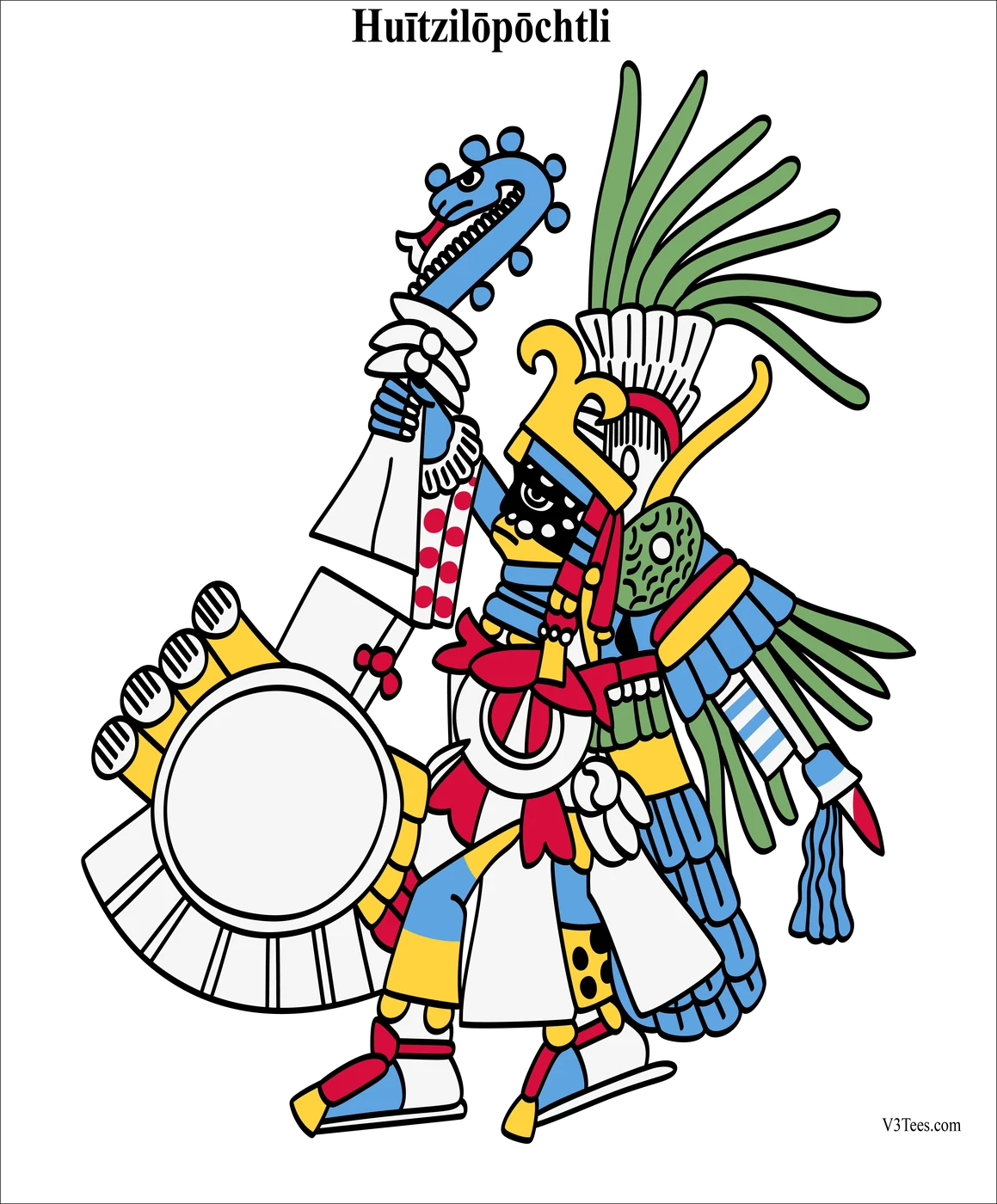
The figure is drawn in the manner of an Aztec codex: flat color, a profile face, a feathered headdress with a hummingbird's features, a shield and weapons, and the name Huitzilopochtli lettered above. Manuscripts in that tradition, including the Florentine Codex compiled after the conquest, recorded Mexica gods in this visual language. The design follows that language. It does not claim to reproduce one surviving folio edge for edge. It presents a god in the graphic style his stories were written down in, and the artwork is offered as a codex-style illustration, not as an ancient manuscript page.
Buy on Amazon
Huitzilopochtli is printed and sold by Amazon Merch on Demand. Choose a product and a marketplace. United States listings come first. Prices change, so they are not listed here.
Standard t-shirt
As an Amazon product, orders, shipping and returns are handled by Amazon.