HomeJulius Caesar
No. 02 · Rome
Julius Caesar
The Roman general whose three-word report from Zela named the brand.
100–44 BCE
LatinVeni, vidi, vici
History
Gaius Julius Caesar was born in 100 BCE into a patrician family that claimed descent from Venus and from Ancus Marcius, an early king of Rome. His career belongs to the late Republic: the civil wars of Marius and Sulla, generals who could pay their own armies, and a Senate that struggled to govern those generals.
He made a working alliance with Pompey and Crassus, the two most powerful men in Rome, and held the consulship in 59 BCE. The prize was a long command in Gaul. From 58 to 50 BCE he campaigned across what is now France and Belgium and twice crossed into Britain, against peoples who had no single king and, until 52 BCE, no single war leader. He wrote the fighting up himself. The Commentaries on the Gallic War are plain, controlled Latin, and they are also a political document addressed to readers at home. By the end of the decade Gaul was under Roman rule, and Caesar was richer and more famous than the old constitution could comfortably hold.
Led by Pompey and by men who wanted Caesar tried as a private citizen, the Senate ordered him to give up his army. In January 49 BCE he crossed the Rubicon, the stream that marked the legal edge of his command, and marched on Italy. Pompey left for Greece. Caesar followed, and at Pharsalus in 48 BCE he broke the larger army. Pompey fled to Egypt and was murdered as Caesar arrived. The Egyptian stay, his alliance with Cleopatra, and a short war in Anatolia came next. At Zela in 47 BCE he defeated Pharnaces II of Pontus so quickly that Roman writers say he reported the battle in three words: veni, vidi, vici. I came, I saw, I conquered.
Back in Rome he was voted a series of dictatorships, the last of them without a time limit, dictator perpetuo, early in 44 BCE. In 46 BCE he reformed the civil calendar, the system later called the Julian calendar, so the civic year would track the sun. He enlarged the Senate, settled veterans in colonies, and planned a Parthian war he did not live to begin. On 15 March 44 BCE a group of senators stabbed him to death at a meeting held in the Theatre of Pompey. They called the killing a restoration of the free state. Another civil war followed. The winner was his adopted heir, the young Octavian, who became Augustus. The Republic's old form of government did not return.
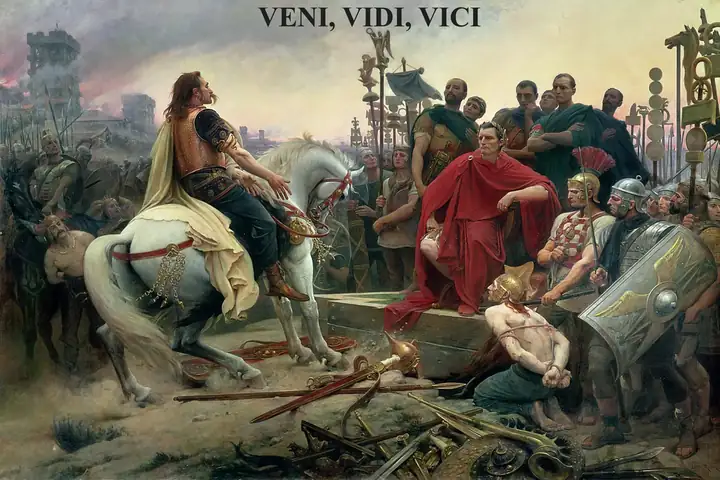
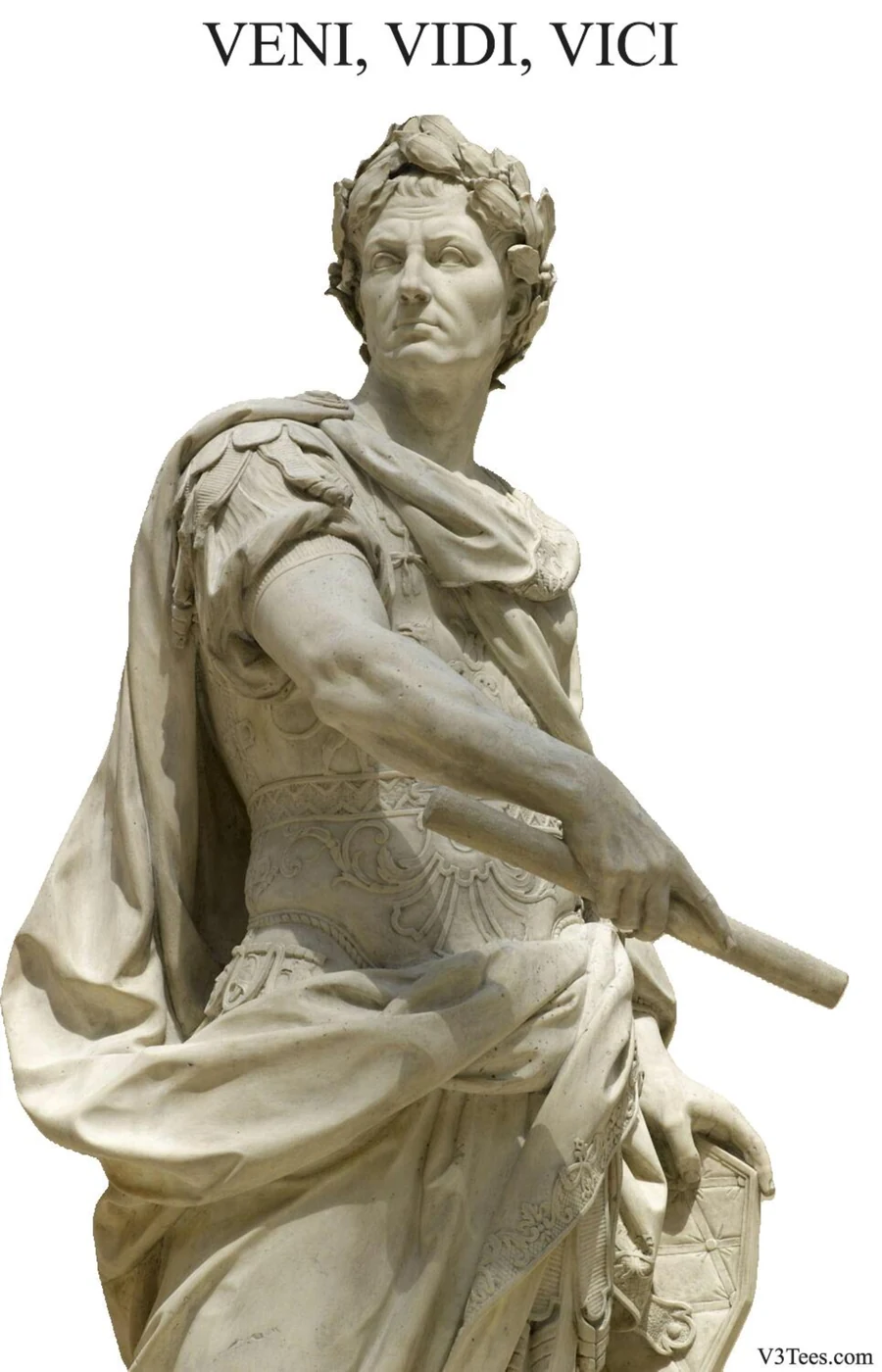
Caesar names the brand because the three verbs are his report from Zela. He is also here as the other half of Alesia. The Gallic War that made him was the war that destroyed the independence of Vercingetorix's coalition, and the lineup would be thinner if it showed only the Roman side of that siege. The shirt reproduces an eighteenth-century marble of him and sets the Latin words above the figure.
About the art
The statue is Jules César by Nicolas Coustou (1658–1733), a marble about 2.4 meters tall in the Louvre, inventory MR 1798. It was commissioned for the royal gardens, carved between 1696 and 1722, and signed and dated 1722 on the plinth. It entered the Louvre in 1872. Coustou shows Caesar laureled, in cuirass and cloak, one hand lowered with a commander's baton and the other beside a shield. The words VENI, VIDI, VICI above the figure are part of the shirt design. They are not an inscription on the marble. The sculpture is public domain.
Buy on Amazon
Julius Caesar is printed and sold by Amazon Merch on Demand. Choose a product and a marketplace. United States listings come first. Prices change, so they are not listed here.
Standard t-shirt
Premium t-shirt
V-neck t-shirt
Tank top
As an Amazon product, orders, shipping and returns are handled by Amazon.