HomeShaka
No. 08 · Zulu Kingdom
Shaka
The king who turned a small Zulu clan into the dominant power of the region.
c. 1787–1828
History
Shaka kaSenzangakhona ruled the Zulu from about 1816 until his death in 1828. He was a son of Senzangakhona, chief of a small Nguni clan in what is now KwaZulu-Natal, and of Nandi. His birth sat awkwardly in his father's household, and the stories of his childhood are stories of slight and of years spent away from home. He attached himself to Dingiswayo, ruler of the larger Mthethwa confederacy, and learned war in that service. When Senzangakhona died, Dingiswayo backed Shaka's claim. Shaka took the Zulu chieftaincy and began turning a small clan into a kingdom.
The military changes tied to his reign are why the name traveled. He is credited with making a short stabbing spear, the iklwa, the main weapon of a close fight, in place of the older throwing spear, and with a taller cowhide shield used to hook an opponent's shield aside. Young men were grouped in age regiments, the amabutho, and held to longer service. The attack associated with him, often called the chest and the horns, set a holding force in the center and faster wings on either flank to close around the other side. How much of this was his own invention, how much was already changing among the northern Nguni, and how much was sharpened by later storytellers is still debated. The direction of his reign is not. The Zulu ceased to be a minor clan and became the dominant power of the region, absorbing some neighbors and driving others out.
The wider upheaval of these decades, often called the mfecane or the difaqane, scattered communities across southeastern Africa. Older histories laid almost the whole of it at Shaka's door. More recent scholarship spreads the causes: drought, competition over trade, the slave trade at Delagoa Bay, and the rise of several strong states in the same generation. Shaka is central to the Zulu part of that history. He is one cause among others. The detailed portrait of his character, including stories of arbitrary killing, comes largely from books by British traders who lived at Port Natal in the 1820s, Henry Francis Fynn and Nathaniel Isaacs among them. Those books are sources. They were also written by men with reasons to make a powerful king look monstrous, and historians use them with care.
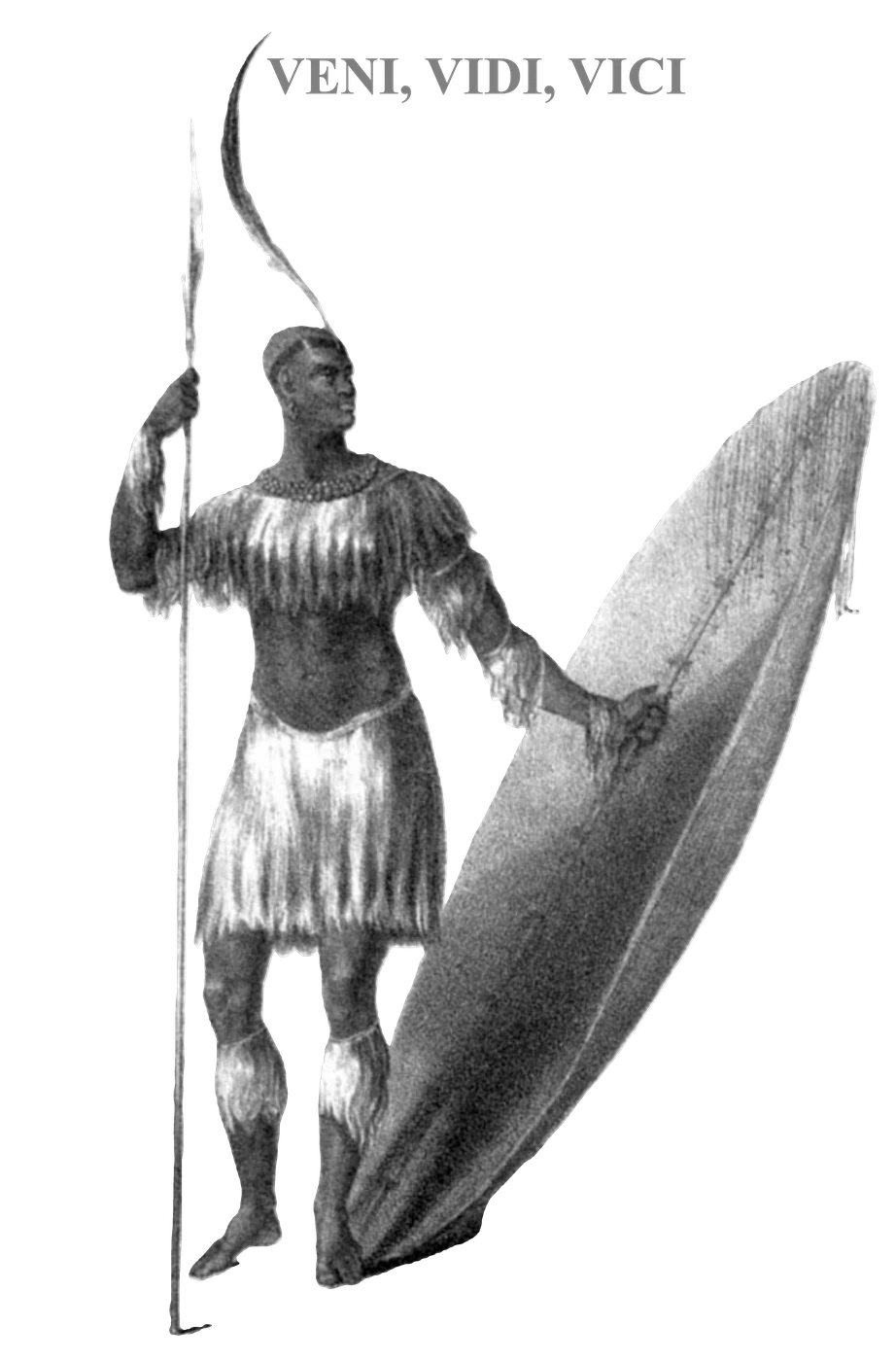
In 1828 his half-brothers Dingane and Mhlangana assassinated him. Dingane took the kingship. The kingdom did not end on that day. Under Dingane, then Mpande, then Cetshwayo, it met the Boer republics and, in 1879, the British Empire. Shaka is in this lineup because the Zulu military reputation those later wars made famous was built in his reign, and because a catalog of commanders that stays inside Europe and East Asia leaves out a state that changed southern Africa in a little more than a decade. The figure on the shirt is an illustration. No reliable likeness of his face from life is known.
About the art
The image is a monochrome illustration of a Zulu warrior standing with a cowhide shield and a spear, labeled Shaka Zulu. It is not a portrait from life. Shaka was killed in 1828, before photography reached the kingdom, and no dependable contemporary likeness of his face is known. The drawing follows the later illustrator's idea of a Zulu soldier: the oval shield, the upright stance, the weapons associated with the reforms of his reign. It is an illustration for a historical name, and this page treats it as one.
Buy on Amazon
Shaka is printed and sold by Amazon Merch on Demand. Choose a product and a marketplace. United States listings come first. Prices change, so they are not listed here.
Standard t-shirt
Premium t-shirt
Long sleeve t-shirt
As an Amazon product, orders, shipping and returns are handled by Amazon.